
This is my list of the 50 red flags in a relationship to help you gain insight on what you experienced and start to name it.
My guess is you’re out of a relationship that never felt right, but you couldn’t pinpoint exactly why. And now you’re looking back, trying to make sense of it all and questioning whether it was even abuse. Or maybe you were just “overreacting”?
If you’re asking yourself that, I think you already know there was something seriously wrong – you just need the proof.
Which is exactly what this list will do for you:
It’ll reveal the patterns you couldn’t see when you were in it. Because when you start ticking off 9 or 23 red flags that happened in your relationship, the evidence becomes undeniable.
I know 50 sounds like quite an overwhelming number, but you’re not looking for a full-house. The 50 red flags are just there to give you examples to look out for. So you can notice the problematic behaviours, the ones that kept repeating, and the ones that felt wrong at the time but you didn’t have a name for yet.
(If only this was something they taught us in school, eh, we’d date far fewer assholes)!
My mission is simple:
To help you stop doubting your reality, validate your instincts and make sure you never talk yourself out of those red flags again. So consider this list your permission slip to label it what it was and give you the language to describe it.
Want to tick them off as you read? Download your own red flags checklist now, tick as you go and watch your proof pile up. (It’s harder to talk yourself out of what happened when it’s physically staring up at you from the page)!

What’s a red flag?
First things first, a red flag is a subtle sign that you choose to ignore. It’s something that doesn’t sit well with you but you move past it because you like the person too much.
Like, chatting to a guy on a dating app that you really fancy. But he suggests a first date at his place. Now not only could that be dangerous, but it’s also very forward. It kinda suggests they want to get physical rather than make the effort to get to know you.
Why do we miss red flags?
If you’re reading this, chances are you’ve already missed a few red flags and have had your fair share of “interesting” relationship experiences. And now you’re looking back, wondering how you missed so many warning signs.
The thing is, you miss red flags because narcissists are designed to go unnoticed. They’re brilliant at masking abuse as love, control as care and manipulation as charm.
Seriously, who hasn’t met at least one charming person who seemed too good to be true… And, well… turned out to be exactly that?
Now, don’t get me wrong; I’m all for adventurous souls and unique experiences. But sometimes we don’t pay enough attention to what our intuition is telling us. And I think thats because we’ve not learned enough information to back our gut feeling.
So we override that little voice inside of us – the one with the flashing neon warning sign. And we end up in a toxic nightmare instead, wondering how we got there.
Look, there’s no shame in making a few dating blunders along the way. But if you equip yourself with the ultimate defence – knowledge – you’re less likely to make the same dating mistakes again. So this list is about empowering you with the knowledge to validate your intuitions and make wiser choices when it comes to matters of the heart.
The red flags you miss when dating a narcissist
If you’ve had a relationship with a narcissist, you’ll notice afterwards how many red flags you dismissed in the beginning. I brushed past a lot of details that didn’t sit well with me. Like, he was always known to have a girlfriend, so he didn’t want people to know we were together. He’d also drunk called me a few times where he sounded absolutely steaming. He even pushed a woman in the street who stepped in his way once!
And that’s not a lot of info to go off in the beginning. But when you couple them with how quickly the ‘I love you’s’ came, the overwhelming attention I got from him. And how he questioned some of my friendships, it does start to paint a picture of what he was like.
So instead of brushing past these small details, it’s about making a mental note of them. Which I know doesn’t sound very romantic and like you’re screening someone for a job!
But when you’ve been hurt. Or feel like you keep making the same dating mistakes, then you need to have something in place to protect you. Something to keep you accountable and in control of picking your partners.
Because when you’ve dated a narcissist you feel powerless after. You’re completely blindsided by the fact your partner was abusive. So it’s natural to fear it happening all over again. And knowing the red flags might just help with reducing that impact — even if it feels weird at first.
Let’s get started
We’re going to decode their mixed messages and shine a spotlight on the 50 red flags in a relationship. And hopefully as you read through them, you’ll recognise the patterns that never made sense to you at the time.
The narcissistic abuse cycle
Narcissists tend to have relationships that follow a pattern known as the narcissistic abuse cycle. It’s basically how they mask their abuse. And that’s what you’re trying to detect when you reflect on your relationship. You’re looking for patterns that kept repeating.
Which is why I’ve categorised the red flags under each stage of the cycle. That way you can look for signs that happened in the beginning of your relationship – the love bombing stage. And then you can see how your relationship progressed to the devalue stage – the middle of the cycle. Followed by the discard stage when they either dumped you temporarily, or permanently.
Of course, the cycle can restart again and keep on repeating if they hoover you back in. So the key with spotting a narc is to try and notice the patterns early before you get in too deep. That way you can make more informed decisions about who you’re dating.
Disclaimer:
This is no easy task. Narcissists are difficult to spot – they fool therapists and smart, capable women like you, all the time. So please be gentle with yourself when reading through this list. It’s not here to make you feel stupid for missing the red flags. And rather it’s to show you that there were real signs, you didn’t imagine them, and yes, they were abusive.
50 red flags in a relationship, part 1:
Idealising – AKA love bombing or the honeymoon stage
You’ve just met someone who seems incredible. It’s like they’ve stepped out of your wildest dreams – they’re charming, attentive, and everything just feels… perfect. Welcome to the idealisation stage of the narcissistic abuse cycle!
This is where things kick off with a bang. Your new partner showers you with attention, like they can’t get enough of you. Claiming you’re their “soulmate” and making you believe you’ve found “the one.” It’s like you’re in a romcom and you’re the leading lady.
But thats not to say you wont notice any red flags. They can still act inappropriately in between the admiration.
Here’s what to look out for:
🚩 1. The relationship progresses quickly
Fast paced is a big hint you’re with a narc! It’s intense from the beginning, so you’re seeing each other a lot, talking marriage, moving in – you name it.
You don’t notice what’s happening when things move so fast. Because you don’t have time to process anything, you’re just swept up in all the magic. So you’re not gradually building on anything together, it’s all superficial.
🚩 2. Future-faking
“I can’t wait to marry you”, “I can’t wait to travel with you” – they’re promising you everything you want to get you hooked on them.
Future faking encourages hopeful thinking. So, they’re taking your attention away from the present and getting you invested in what could be. And it’s important to notice this because it buries a lot of problematic behaviour. It gets you to hold out for something better rather than acknowledge your reality.
🚩 3. They speak badly of their exes
They might tell you their ex was “crazy” or how badly treated they were. And this can do many things, like focus your attention away from them. Or even get you to feel sorry for them. But it could also be a marker for how they might talk about you behind your back. It’s not very respectful to bash your ex to a new partner – even if they deserved it!
🚩 4. They speak greatly of their exes
On the flip side, they might also praise their ex. But that can make you feel inferior and like you need to work hard to prove yourself to them. Again, it’s kinda distracting you from them as you’re now wrapped up on their ex and who they were. It makes you compare yourself and feel insecure.
🚩 5. Claim a ‘soulmate’ connection
Exactly what it says on the tin! They’re mirroring everything you desire in a partner.
It’s tricky because we’re not taught to pick apart positive behaviour as it feels amazing to hear. But if they’re saying it straight off the bat, it’s a bit too soon to tell if someone new is your “soulmate”. I don’t think my current boyfriend and I had that chat until way into our relationship; when we were certain about one another.
🚩 6. They’ve had a lot of relationships
They might not shed any light on their relationship history until you’ve known each other for a wee while. But in saying that, my ex’s history came up pretty quickly. It was used as a way to keep our relationship on the down low. He didn’t want everyone knowing he had another girlfriend again. And that’s because narcissists always need a supply. They get bored easily and need constant stimulation. So they jump from relationship to relationship when the excitement wears off.
🚩 7. Excessively kind, showy behaviour
This can look like extravagant gifts and fancy dates. But it seems a bit over-the-top, like unwanted generosity, as though you owe them for it.
🚩 8. Charming
This is when you find yourself questioning whether they seem too good to be true. Try not to look at charm as being a good thing. Because it’s what helps get you addicted to them. Their charming behaviour makes you want more of it – you want more of the good thing.
🚩 9. False flattery
It’s dishing out compliments that actually come with underlying demands. So they’re buttering you up, but they have ulterior motives.
Like your partner telling you, “You’re the only one who truly understands me. I don’t know what I’d do without you.” Sounds cute, right?
But here’s the twist:
When you want to talk about your own stuff, suddenly it’s like they’re too busy or not interested. So they’re using those nice words to kinda make you feel responsible for their happiness. And you end up putting your own stuff on the back burner to help them instead.
So the compliment is never about you, its about what they want and need.
🚩 10. They appear to move around a lot
Narcissists upset a lot of people. Which could be a reason why they never stay in one place for too long. Or why they have to change jobs frequently.
🚩 11. Careless with money
Not every narcissist is the same. But they like new, shiny things, they seek novelty and excitement. And money can buy those things. They like to portray a successful image and living extravagantly shows that.
🚩 12. Trouble maintaining relationships
Because narcissists tend to use people for personal gain, their friendships can be quite shallow. They thrive on attention and admiration from others. So skipping from friend to friend, gives them a fresh supply. And new friends means they’re not aware of their previous actions.
They’re also self-centred and don’t think about other peoples needs. So as soon as someone catches onto that, they probably don’t want that in their life!
🚩 13. They’re obsessed with social media
Social media allows narcissists to project their perfect life online. And in doing so they can get even more validation. It’s a place for their ego to be stroked because they can appeal to a wider audience.
And a big following can make them look deceivingly trusting. Because it also gives them social credit; if they’ve got thousands of followers, it looks like thousands agree with them.
And if they’re obsessed with social media, they might show you off on there too, like you’re a trophy. But on the flip side, they could also keep you secret. They might not want people to know they’re in a relationship – especially if they’re a cheater.
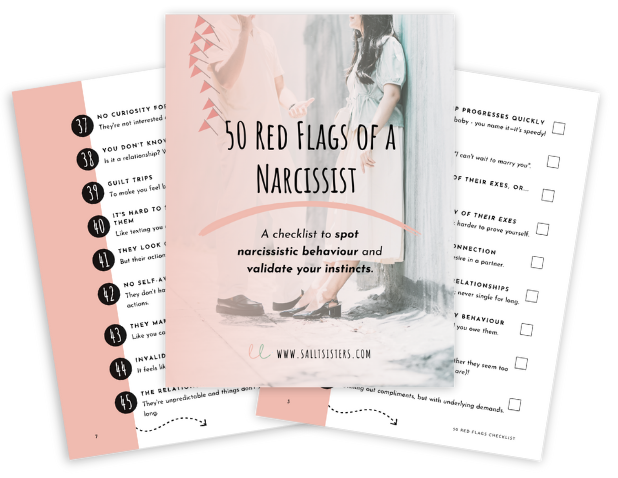
50 RED FLAGS OF A NARCISSIST CHECKLIST
Tick off the behaviours you experienced and see the pattern you couldn’t see when you were in it.
Stop second-guessing yourself and start calling it what it was – you’re not imagining it.
50 red flags in a relationship, part 2:
Devaluing stage
Now for the devaluing stage.
Behind all this intense affection and praise, there’s a different story unfolding. Remember that too much of a good thing can sometimes be a sign of something not quite right? Well, you’re about to find out how it can take a turn for the worse.
Suddenly, your partner’s compliments become scarce, and those kind gestures? They seem to have vanished into thin air. One moment they’re showering you with love. But the next, they’re criticising your every move.
They’ve gone from introducing you to their friends and family. To getting upset when you spend time with your friends. Or suggest doing something on your own. It’s as if they want you all to themselves.
You might feel like you’re walking on eggshells, never knowing what’s going to set them off. This devaluing phase really messes with your self-esteem. And leaves you wondering what you did wrong all the time.
But it’s not about you. Nope, it’s about their need to control, manipulate, and keep you under their thumb. It’s like they’re the puppet master, pulling the strings to keep you off balance.
The below red flags won’t necessarily happen in the devalue stage; you could also see them in the idealising stage. It really depends on the narcissist and what they give away in the beginning stage. But their bad behaviours tend to start showing once they’ve “got you”.
Here’s what to look out for:
🚩 14. Pity plays
Feeding you a sob story to make you feel sorry for them. My ex made me feel really bad for him. He told me stories about his ex fiancé cheating on him. Or terrible accounts of his time fighting in Afghanistan. I’m not saying what happened to him wasn’t awful. But it was when he would tell me about it – it always followed when he’d done something wrong. So it was used to excuse his behaviour.
🚩 15. Shows signs of being disrespectful
If they’ve got a habit of not treating people well, it could be a sign somethings off. If they’re openly disrespectful and don’t seem to care, it’s worth paying attention to. Notice how they speak about their friends behind their back – they could also be speaking like that about you.
🚩 16. Hypocritical
Narcissists can be hypocritical because they prioritise their own desires and image over consistent values. So it’s not unlike them to say one thing while doing another to serve their own agenda. For example, saying they don’t approve of you taking drugs. But being perfectly ok with themselves doing it!
🚩 17. They aren’t the same in private
Narcissists often switch behaviour in private because they feel less pressure to maintain a façade. They reveal their true selves and tendencies when they think fewer people are watching or judging them.
🚩 18. They don’t take accountability
They avoid taking accountability because they dislike admitting they’re wrong. And they’d rather shift blame onto others to maintain their self-image. When someone can’t apologise for their wrongdoings, it builds resentment because problems never get resolved fairly.
🚩 19. You feel nervous when they get angry
Not a good sign to be scared of your partner when they get angry. Even if they don’t hit you, fearing your safety because they smash things, or get too close to you is still abusive behaviour. It also shows they don’t know how to express their anger in a healthy way.
🚩 20. Controlling behaviour
Controlling behaviour can mask itself as caregiving. So it can be saying things like, “I trust you, and I don’t want anyone to come between us.” But as time goes by, those hints become more direct, like, “do you think you could cut back on seeing him?”
Before you know it, you realise you’ve been gently guided into minimising your interactions with friends. They’ve wrapped their controlling behaviour in a caring ribbon. And because it’s happened so gradually, you hardly notice that it’s become your new normal.
But it can also look like narcissistic gaslighting because they’re controlling your view of reality. They’re dictating how you see things.
🚩 21. Problems with alcohol or drugs
Not all narcissists have problems with drugs and alcohol. But some of them do. And my ex was no different. It can come across like they’re a ‘casual’ user. But then they’re shitfaced, waking you up, pissing on the floor next to you!
So if they’re trying to hide their drunken behaviour or downplaying it, it can point to signs of an addiction.
🚩 22. Arrogance
We sometimes confuse it with confidence and think we like that quality in a person. But you’ll notice their arrogance when they’re constantly bragging about their accomplishments. Or your conversations seem to always be focused on them, and not about you.
🚩 23. They don’t appear to be listening
I feel like this becomes really obvious when they’re done charming you. It’s like whatever interesting thing you have to say, they couldn’t care less about. They come across bored and don’t even hold eye contact. And it’s as soon as the conversation becomes about you, they switch off.
🚩 24. Show signs of possessiveness
Narcissists can be very demanding and expectant of your attention. Wanting to know where you are and what you’re up to. But that won’t be reciprocated. And again, this can come across as loving. But underneath it all, they’re extremely possessive and want you all to themselves.
🚩 25. Friction when you try to set boundaries
For example, you tell them you want some alone time. And they get all upset, saying things like, “why would you want to be alone? Don’t you want to be with me?” They make you feel bad for wanting to have your own space. They want to control every little part of your life and don’t like it when you assert yourself. So instead of respecting your boundaries, they kind of push back and create friction.
🚩 26. Contrasting behaviour
You know how when you first met them, they were all caring and understanding, really showing they get you? But now, they’ve flipped the switch and their empathy totally vanished. One moment they’re all about your feelings, and the next, they don’t even care. They’ve hooked you in, but once they’ve got you, they drop the whole caring act.
🚩 27. Inconsistent past details
Their stories about their past keep changing which can be a sign something’s up. If they can’t keep their facts straight, they’re probably lying to you and can’t keep track of their own lies.
It’s ok to forget stuff sometimes, we all do. But when there are blatant lies or things don’t add up, it’s a bit fishy. So pay attention to those inconsistent details – they could be trying to hide something or be signs of gaslighting.
🚩 28. Jealousy
When you’re amidst the devaluing stage, they might start showing jealous behaviour. And this can come across like victim playing. But it’s used to isolate you and make you distance yourself from other guys. For example, making you feel sorry for them by telling you about their past cheating experiences. And this can make you feel guilty and cause you to stop spending time with others.
It can also be as obvious as them not being happy for other peoples accomplishments. They like being the centre of attention. So anyone that steals the limelight from them is the enemy!
🚩 29. Non committal
Because they’re always moving about, they try to not have any commitments they’re afraid of leaving behind. Their lack of commitment also shows they’re not as invested as they seem. So if they don’t want to label your relationship, it’s a sign they don’t plan to stick around.
🚩 30. Critical of your friends or family
Narcissists are trying to cut you off from your circle, so that they can isolate you from them. And they do that by discouraging you from hanging out with friends and family to make you feel uncomfortable.
🚩 31. Forgetful
Ever notice how narcissists act like they completely forgot about stuff, even when it’s something important? Like you could’ve had a big argument. But they don’t remember what you’re talking about when you bring it up. It’s because they’re pretending they don’t, or they just want to deny it ever happened. That way they can dodge taking responsibility or avoid dealing with stuff.
🚩 32. Sensitive to criticism
Narcissists can’t handle the tiniest bit of criticism. They get all defensive and upset when you point out something they did wrong. They don’t take it well because deep down, they’re insecure. So, if you’re scared to be honest because you might upset them, that’s a red flag.
🚩 33. Inconsiderate to strangers
Seeing people be rude to service people is my biggest pet peeve! It’s also something overt narcissists tend to do. And it really shows how unempathetic they are and their lack of compassion for others. So watch for how they interact with strangers, it can be a real indicator for things to come!
🚩 34. Overreact suddenly
Ever heard of narcissistic rage? It’s blowing up over the small stuff which is intense to witness. Especially when you’ve gone through love bombing, it’s quite the change in tempo. And that’s confusing to see because it’s so far from the behaviour you were used to. But pay attention to when it happens, it’s usually caused by their insecurities.
🚩 35. Your relationship doesn’t feel equal
Relationships with narcissists never feel balanced. You’re always pouring more into them, than they are to you. Love with them feels one sided and like you’re forever trying to make it work. Healthy love feels safe and equal. And it’s exhausting when it’s not.
🚩 36. You walk on eggshells around them
Diminishing yourself to keep the peace isn’t authentic. And over time it’ll grind on you. You shouldn’t be tiptoeing around them, desperately trying to avoid conflict. Relationships need open and honest communication to work.
🚩 37. No curiosity for how your day was
Honey, if they’re not curious about your day to day, they’re not interested in your life. Which kinda shows they don’t care about what makes you you. They don’t think you’re important to their life. And that’s a big sign that they don’t appreciate you.
🚩 38. You don’t know where you stand
Worrying that your partner could up and go at any moment doesn’t feel very safe. But that’s honestly how it feels when you’re with a narcissist. You never know where it’s going or if you’re ‘official’. And if the relationship is unsettling, that’s a red flag. You can’t build a future with someone who doesn’t know if they want to stick around. And why should you?
🚩 39. Guilt trips
Guilt tripping you is intentional manipulation. And narcissists use it to make you feel bad about yourself, like you’ve done something wrong.
When that guilt starts creeping in, just ask yourself “did I actually mess up”? Because they’ve trained you to believe that if you don’t go along with their wishes, you’re automatically in the wrong.
Think about it – every time you’ve said “no” to what they want, you’ve probably faced consequences. Like gaslighting, temper tantrums, or silent treatments. And of course, they’ve been quick to point fingers and sling blame. They’re masters at making you feel bad.
🚩 40. It’s hard to spend time away from them
Having your own time is perfectly okay. And if they’re having trouble letting you do that, it’s a warning sign.
🚩 41. They look good on paper
Narcissists are often skilled at saying all the right things. But their actions may tell a different story. Look for consistent behaviour and follow-throughs on promises. Try and concentrate on the facts of who they are, rather than the idea you have of them.
🚩 42. No self awareness
They lack self awareness and don’t reflect over their actions. And that’s because they don’t stop to think about their impact on other people; they don’t care. They’re never the problem, it’s always someone else.
50 red flags in a relationship, part 3:
The Discard stage
You still with me?
This is a long one, I know. But you’ll feel so much more confident with spotting red flags in relationships after you’ve spent time reading all 50.
Right, on to the final stage – the dumping!
So, after the love bombing and the confusing devaluing stage, here comes the discard. And it’s as cut throat as it sounds! That partner who seemed so into you starts acting like you mean nothing to them.
They might just up and leave without much explanation, or disappear and ignore you for a period of time. Or drop hints that it’s over, leaving you feeling bewildered.
It’s not a healthy breakup where you both part ways. It’s more abrupt and leaves you shocked and hurt. You could go from spending time together, where everything seems fine. To a sudden stop in communication; ignoring your calls and cancelling plans. It’s confusing and painful, as hell.
The biggest red flag is obviously them leaving you. But you’ll also notice these too:
🚩 43. They make you feel needy
This has a lot to do with trauma bonding. That addictive feeling you get from the constant ups and downs. And it really comes to light when they leave you. You feel like you can’t live without them and you don’t know who you are without them.
🚩 44. Invalidate your emotions
Your needs should be just as important as your partners. And if it doesn’t feel like that, then they don’t care much for your happiness. It’s ok to have needs and boundaries, they’re what protect you. So if they’re not being met, you’ll never be fulfilled in that relationship.
🚩 45. The relationship feels chaotic
This is what living in a cycle feels like. It goes from good, to bad, to much worse. And then its back to good again. This unpredictable nature is what makes the relationship feel so chaotic. You’re never happy for long. And trust me, healthy relationships aren’t that extreme. They plateau and feel calm.
🚩 46. They care about how they’re perceived
Narcissists care so much about what others think. It’s always about preserving their image to everyone. It’s why they’re so good at hiding their abuse – because they don’t want to get found out and look bad. And this is noticeable in their apologies as it’s always about their image.
It’s never about the harm they’ve caused and trying to make amends. It’s always about “how did that make me look to others”.
🚩 47. They don’t compromise
You’re always the one bending over backwards to make things work. If it feels like you’re doing all the adapting and the other person isn’t budging an inch – that’s a red flag. A healthy relationship is a two-way street where both people give and take.
🚩 48. Unable to resolve conflict healthily
There’s no resolution with narcissists because they don’t know how to healthily resolve conflict. They usually resort to behaviours like stonewalling. Or frighten you with their rage instead. And that’s because they’re trying to avoid dealing with the issue altogether. You should be able to openly communicate with each other, even when things get tough.
🚩 49. They bring the worst out in you
Being with a narcissist brings out all your negative feelings. They make you feel insecure, you doubt yourself, or you’re paranoid all the time. So if being with them makes you feel like you’re not good enough. Or it triggers all these bad vibes – that’s a massive red flag. You don’t want to be spending your time with someone who brings that all out in you. They should be lifting you up, not tearing you down.
🚩 50. Lack empathy*
Their lack of empathy will really come to light in the discard. Especially if they give you the silent treatment, you’ll soon get a taste of how cruel they can be.
You’ll also spot it when you’re excited about sharing your thoughts and your partner just doesn’t give a shit. But that’s because they don’t care about your feelings and interests. And you deserve someone who does.
*Note that they can fake empathy when needed.
So there you have it, all 50 red flags in a relationship! (AKA the longest blog you’ve ever read)!
Make sure you’re aware of them and you understand how to spot them.
But knowing the flags is only part of your healing. You also need to set yourself standards.
Don’t just spot the red flags – act on them too
It’s hard to spot a narcissist, especially when they lead with their best foot forward. So you won’t tell straight away. But over time, as you know, they start to reveal themselves.
Dating can carry a lot of excitement, coupled with apprehension. There’s also an underlying panic if you haven’t met anyone in a while, so that can build some pressure too.
So you need to take your time getting to know someone before you rush into a relationship with them. When you slow down, you have time to evaluate your situation, your wants and your needs.
So if you meet someone that doesn’t meet your expectations, their manipulation won’t work on you. Because you’ll notice they’re trying to change what you want to suit their needs instead.
And that doesn’t work on someone who’s secure in what they want. So model the standards of relationship you want and don’t be lead by what they’re doing.
I know this is undoubtedly challenging after a narcissistic relationship. Because you’ve lost sight of what a healthy relationship looks like. And you’ve had to relearn what’s acceptable behaviour.
But these 50 red flags in a relationship are what you shouldn’t be accepting. And ticking them off in your checklist shows you that visual proof of the behaviour you questioned, and also validates why you did. Because on some level, like me, I’m betting you did know how they behaved wasn’t actually okay – it’s just that their manipulation overpowered your self-trust.
Which is valuable information for your healing; it’s highlighting that you need to rebuild your self-trust. So when it comes to dating again, you’ll know what you want. You’ll have standards and you’ll respect them when someone else crosses them a few too many times.
Remember: they don’t have to portray every single red flag.
But if their behaviour becomes repetitive and harmful to your well-being, then it’s time to get out.
Look for the warning signs, pay attention to them and don’t ignore them.
Please type a 🙋♀️ in the comments below if you stuck with me all the way through!
🙋🏻♀️
Yes!! Hope it helped you