

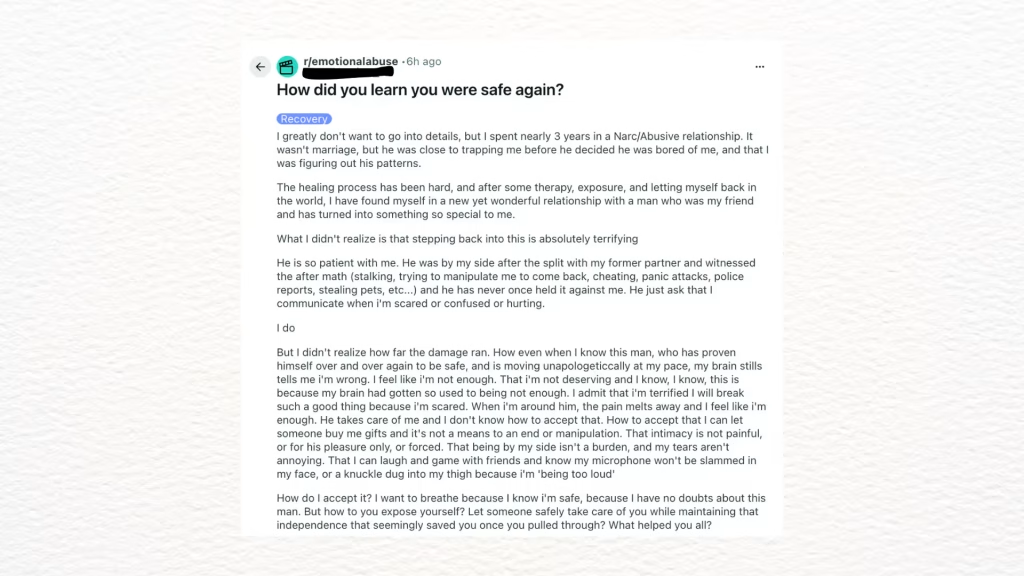
A woman posted on Reddit recently asking something so many survivors ask and never get a straight answer to.
She’d got out of an abusive relationship, had invested in therapy, and was slowly integrating herself back into the world again. She’d even found a wonderful partner — a man who’d been beside her through the aftermath, who watched her go through stalking, panic attacks and filing police reports, and never once held it against her. He was patient, moved at her pace and she was able to communicate her fears with him.
And yet, despite the healthy relationship, her anxiety felt worse.…
“My brain still tells me I’m wrong”, she wrote. “I feel like I’m not enough… I’m terrified I will break such a good thing because I’m scared… I don’t know how to accept that I can let someone buy me gifts and it’s not a means to an end. That intimacy is not painful, or for his pleasure only, or forced. That my tears aren’t annoying. That I can laugh… with friends and know… a knuckle [won’t be] dug into my thigh because I’m ‘being too loud.'”
She ended with: How do I accept that I’m safe?
If you notice a tingle of resonance as you’re reading this, then chances are you’ve experienced that same anxiety in a healthy relationship after narcissistic abuse. It’s a common fear to have, because no one wants to relive another chaotic and abusive relationship again.
But what doesn’t make sense is how can being with someone good make your nervous system feel worse?
This post explains why that happens, and what helps to combat that.
RELATED: If you’re still wondering whether you’re ready to date yet, this post might answer some of your questions: how do you prepare for dating after narcissistic abuse?
What is Anxiety in a Healthy Relationship After Narcissistic Abuse?
Anxiety in a healthy relationship after narcissistic abuse is your nervous system running old predictions about safety and threat onto a new person. Because your brain hasn’t yet updated the model it built during the abuse.
It’s not a sign the relationship is wrong, and rather a sign you haven’t healed enough yet. It’s what happens when your brain has years of data saying that closeness comes with a cost. And a new partner who keeps proving it doesn’t.
The data hasn’t caught up yet. So your body stays on alert, even when the evidence in front of you says you’re safe.
When a Good Thing Still Feels Like a Threat
When Toby and I got together at the tail-end of 2019, I was so not ready for a relationship yet. And I knew that (my therapist probably knew that too, though she was kind enough not to say it quite so directly).
I was living with complex PTSD, a hair-trigger stress response, and an internal alarm system that treated a delayed text like the end of the world. So when reliable Toby showed up kind and calm, I didn’t feel relieved — I felt suspicious. And when things were good, I felt dread. Because in my previous relationship, good things always turned sour.
Why does kindness put you on high alert?
Kindness puts you on high alert because your brain filed it under danger — it learned that gestures came with strings. Let me explain why that happens with with a personal example:
Early on, Toby surprised me with a romantic weekend away: to the same destination my ex had taken me to a few years before. And instead of feeling grateful, my whole body sprang to alert like a deer in headlights. The beat of my heart as loud as a subwoofer, shoulders pinned to my ears, and a sick feeling in my stomach like something bad was about to happen.
My brain had filed that destination, that level of gesture and effort all under the category of danger. Because the last time someone did something like that for me, it came with strings. It was buying compliance, or burying bad behaviour, or setting up a situation where I’d owe him later.
And Toby just wanted to surprise me and make me feel special.
And as I revealed at the beginning of this section — we’re still together, and things are completely different now. But that only happened because of specific things I did consistently over time (which I share below).
So if you’re feeling anxious as hell right now and questioning everyone’s motives, know there’s nothing wrong with you. Your brain is doing exactly what it was trained to do. And once you understand what that means, you’ll finally be able to stop fighting yourself and start working with your system instead.
Why Does Anxiety in a Healthy Relationship Feel Worse Than the Anxiety you Felt During the Abuse?
Anxiety in a healthy relationship can feel more intense than the fear you felt during the abuse, because your nervous system has moved from a known, adapted pattern into an unfamiliar one. And unfamiliar reads as threat, even when it’s safe.
Here’s what I mean:
Your brain is a prediction machine. So rather than waiting for something to happen and reacting to it, it’s constantly using your past experiences to forecast what’s about to happen next — and it prepares your body accordingly.
So when your past experience taught you that a gift came with a sense of “you owe me”, your brain constructs that same meaning against their generosity.
Which is why you might notice that receiving a gift feels uncomfortable in your body. Like your breath is held in, or you feel nauseous in anticipation of what’s to come. That’s because your brain predicted what was about to follow, and started preparing you for it, based on everything it learned before.
When you were with your ex, your nervous system had adapted to the pattern. It knew what was coming, even if what was coming was awful. Now you’re in a relationship where the pattern is different. And unpredictability (even good unpredictability), reads as threat to a system that’s been trained to stay on guard. So your anxiety spikes because your brain hasn’t caught up with where you actually are.
And unfortunately, your brain won’t update those predictions on its own just because you’re out of that abusive relationship now. [I explain exactly why that is in more detail in this post: why you shouldn’t trust your gut after a narcissistic relationship]. It prioritises known patterns over new information because they’re easier and less work for your brain.
So the fact that your new partner is kind doesn’t automatically override years of data that says kindness comes with a cost. Your brain needs something more concrete than time passing. It also needs new experiences, repeated enough to start building a different model.
Do all survivors feel anxious with a healthy partner?
No, not all survivors will feel anxious with a healthy partner, some experience the opposite. Like a feeling of numbness or flatness in a healthy relationship, as though there’s something’s missing because there’s no intensity or chaos. That’s a different response to the same underlying wiring. So if that’s you, the tools in this post will still work in the same way, you’re just expressing a different survival response.
What Triggers Anxiety in a Healthy Relationship?
It’s usually something normal that happens in your relationship that triggers an anxious response, it’s rarely the obvious stuff that sets your nervous system off.
Like your partner goes quiet after a disagreement and your stomach drops. Or he raises his voice at a football match on the telly and you jump like you’ve just seen a snake. Or he says “can we talk later?”, and you’ve already catastrophised he’s cheated on you before he’s had a chance to finish his sentence.
Your partner might be attentive and steady, yet you’re on edge waiting for something bad to happen.
The woman on Reddit put it plainly:
She couldn’t laugh too loud with friends without bracing for punishment. And she couldn’t accept a gift without scanning for the catch.
These are triggers in a healthy relationship — and they’re not a sign you haven’t healed enough to be in one. But they are signs that point to what still needs work. Each trigger is signalling a specific pattern your brain is still running from old relationships. And that’s useful information, because it tells you exactly where your attention needs to go.
Three Steps That Help Switch Anxiety to Safety in a Relationship
1. Notice what’s happening in your body, then slow it down
The moment you feel a spike in your feelings, like a hot flush maybe, or a knotted stomach, or the urge to question their motives — your first job is to notice it rather than act on it.
We tend to skip over this step because things happens really fast, or we’re used to minimising our reactions, saying “I’m fine”. But that dismissal keeps you stuck, because you end up fighting your own system instead of working with what it needs.
So when you catch the response coming, pause and slow down. Take a few breaths where the exhale is longer than the inhale (extending your exhale sends a signal to your brain that says we’re okay right now). Then bring your attention to the room you’re in. Notice the lighting, the temperature, or your feet on the floor.
Your brain has drifted into the past, so grounding yourself in the present helps it register what’s actually in front of you. Because if you were in real danger, you wouldn’t have time to do all that.
If it feels available to you, lean into your partner. Ask for a hug, get some physical contact and feel their warm, relaxed body against yours — this is co-regulation. Your nervous system can borrow safety from another person’s calm body. And that physical experience also helps give your brain present data about the person you’re with. So it can distinguish the difference from your past partner.
The more I practiced this with Toby, the more my nervous system started to register that this relationship operated by different rules. It was slow and messy at first and took a lot of patience. But the repetition is what made the difference.

2. Actively collect safe moments
Your brain has a natural bias towards threat and negative information; it’s a survival mechanism to help protect you. Which means that the good moments in your relationship, will slide right past you unless you deliberately pause to register them.
So when your partner gives you a gift and nothing bad follows (no guilt trips or strings attached), acknowledge that. Say it out loud, or in your head, or write it down: he gave me this, it was generous, and afterwards I felt loved and nothing bad followed.
When you disagree and it gets resolved without anyone storming out or weaponising it three days later, notice it and absorb the positive outcome.
Each one of those moments is new data for your brain. And the more you collect them, the more your brain starts to build a different prediction about how this relationship works.
I used to do this with Toby out loud. I’d say, “thank you for not storming out when things got heated”, or “thank you for the compliment”. Things that were completely ordinary to him but were, for me, new information my brain hadn’t encountered before. He’d look at me a bit baffled sometimes. But over time, those moments stacked up. The gap between the fear response and the moment I realised I was safe got shorter and shorter.
Your brain only updates it’s predictions when you give it enough evidence. So don’t let the good moments go unnoticed.
3. Tell your brain what just happened — in detail
Vague reassurance doesn’t move the needle much. “That was nice” or “I feel okay” gives your brain very little detail to work with. The more precise and sensory you can be, the better.
So instead of: that was a good moment, try: “he noticed I was overwhelmed and he gave me space without making me feel guilty for needing it. When he came back, I felt my shoulders drop and I felt lighter.”
That level of detail helps your brain distinguish what’s happening now from what it learned before. You’re registering safety as a concept and as a physical experience, which is the language your brain runs on.
My audio course, How to Trust Yourself Again, teaches you this exact process. So you can start to build a more accurate picture of who’s safe and who isn’t, and learn to make more confident decisions for yourself.
The Anxiety Won’t Disappear Overnight and That’s Okay
Healing in a relationship isn’t linear. You’ll have stretches where things feel easier, and then something small will knock you sideways and you’ll wonder if you’ve made any progress at all. That’s normal. Your brain has years of old predictions to work through, and only weeks or months of new ones. So it does take time and effort to rewire your default responses.
What changes over time, with repetition, is the intensity and the duration of your anxiety. The fear response gets shorter. The gap between the trigger and the moment you come back to yourself gets smaller. You start to feel less hijacked and more curious (oh, that’s the old pattern again), rather than feeling consumed by it.
There’s nothing wrong with you for feeling anxious in a new, healthy relationship. Your brain just has some unlearning to do and you can help it along by giving it enough new evidence that it eventually builds a different model.
And if you want support doing that work — from a somatic trauma-informed coach who’s been exactly where you are, and has almost spent seven years building evidence with a kind person — you can book a free 30-minute call with me here. We’ll look at where you’re getting stuck and what’s likely keeping those old patterns in place.
If this post resonated, please share it on your socials 🙏🏼 Means the world to me when I see it reaching the women who need it. And if you’ve been through this yourself, drop a comment below with one thing you’re no longer anxious about in your new relationship.
Download the free Boundary Blueprint — includes 6 grounding techniques, scripts for communicating when you’re dysregulated, and a step-by-step guide for building boundaries your nervous system can actually hold. 👉 Get your free copy here.